
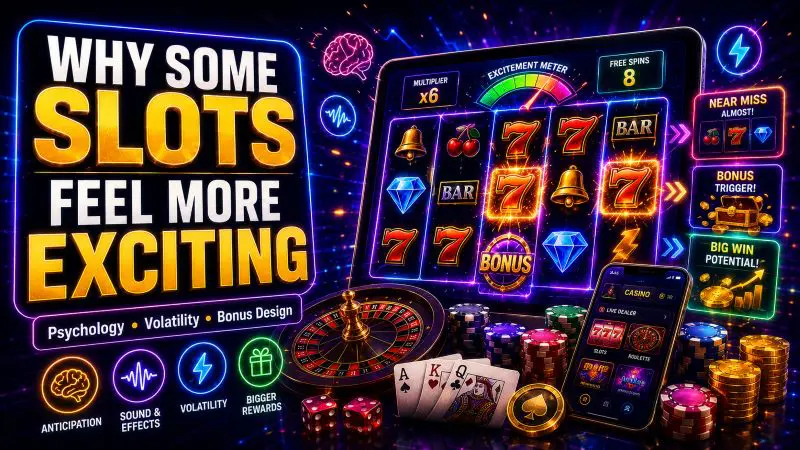
When you first walk into a casino and you’re surrounded by rows of slot machines, you’ve likely noticed that many of them look similar. However, the moment you begin to notice that some of these slots seem to create more anticipation and excitement than others is when the math begins to shine. Understanding why some slot machines seem to elicit more excitement than others requires understanding the interaction of three factors — what’s occurring inside your head, the mathematical principles behind the design, and what you see and hear from the slot machine. I have spent a significant amount of my life attending game development conferences where I’m talking to math team members and players who talk about slots on forums and in casinos. One theme continues to emerge – the excitement generated from playing slot machines isn’t primarily due to the potential winnings; it’s primarily due to managing your expectations minute-to-minute. That’s basically the entire story.
The brain doesn’t care about the win; it cares about the maybe
There is an unpleasant fact about slot machine engagement science – your brain is rewarding you for anticipating a win, not for winning. Dopamine, the chemical released in your brain that is commonly referred to as “pleasure,” releases more rapidly during anticipation than during the actual reward. In neuroscience studies conducted since the late-1990s (many of which involved studying monkeys pressing levers for juice), researchers found that slot machines and other forms of uncertain reward produce variable ratio reinforcement. What that means is that the reward occurs randomly, rather than on a set schedule. Compare this to a simple vending machine – you insert your money, receive a snack, and get on with your day.
There’s no thrill here because there’s no risk. Compare that to spinning a slot reel. Do you know whether it will land on three cherries or two blanks and one wild? Because you have no idea what will happen next, that uncertainty is repeatedly activated hundreds of times per hour. The repeated activation of that uncertainty activates the ventral striatum (the area of the brain that processes rewards). Therefore, the reason slot machine engagement research consistently finds that effective unpredictability in slot machine design leads to sustained attention compared to fixed-payout systems is due to the nature of slot machine psychology – creating anticipation.
Almost-wins and the “oh-so-close”
Slot designers and psychologists have been aware of the almost-win effect for years. The almost-win effect refers to the effect created when a slot machine results in a win combination that falls just shy of a large jackpot. For example, imagine a win combination of three red 7s but instead of having the third 7 in place, you have a blue bell icon in its place. While functionally this is essentially a complete loss financially, your brain interprets this as “you came so close!” Your brain sees this as an opportunity for another shot at getting a win.
Slot designers use this knowledge when designing the probability distributions of symbol placement (reel weighting) to create opportunities for almost-wins to occur with increased frequency while maintaining the overall payout percentage of the slot machine. Near-misses are perhaps one of the more hot-button topics within the gaming community, mainly because they walk a fine line between psychological manipulation and clever design. A well-designed almost-win can generate excitement and anticipation. On the other hand, an almost-win designed to exploit players can create frustration and lead players to become disinterested quickly.
Volatility is the primary lever controlling how exciting a game seems
If you’re trying to identify one concept that can explain why one slot game may feel more exciting than another, it is volatility. Volatility measures how often a slot game pays out and how large those payouts typically are when they do occur. Low-volatility slot games pay relatively small prizes frequently, while high-volatility slot games pay infrequently but can result in large multipliers when they do. Many medium-volatility games fall somewhere in-between.
Here’s a surprising aspect – RTP (Return To Player) and volatility are two separate measurements, and even though two games may have identical RTP values, they can feel vastly different based on how that return is spread out. For example, a low-volatility slot game with 96% RTP may pay relatively small prizes approximately 30% of the time. On the other hand, a high-volatility version of the same game with 96% RTP may only pay out substantial prizes 10% of the time, but those prizes may be 10-20x larger when they do occur.
Hit Frequency affects how exciting a game feels
Another critical factor affecting how exciting a game appears in the short-term is Hit Frequency (i.e., how frequently you receive any kind of prize). A game with a 25% hit frequency will offer a small prize approximately every four spins. The frequency of hits is sufficient to maintain anticipation without leaving long stretches devoid of prizes (which may cause players to perceive the machine has stopped paying).
Bonus frequency also affects how exciting a game feels
How often a slot game offers a bonus round (or free spins feature or pick-a-prize mini-game) determines the pace of the session. If a slot game triggers its big bonus too seldom, players may leave before seeing anything worthwhile. Conversely, triggering it too frequently can reduce perceived value and create a routine experience.
Good sound design generates excitement
Casino floors are filled with the sounds of spinning wheels, clicking buttons and ringing bells. Walk into a casino with your eyes closed and you can usually tell immediately which slots are paying out simply by listening to the sound design. Win sounds are often written in C Major or other bright consonant key signatures because C Major chords activate positive emotion processing pathways in virtually all humans regardless of culture. Loss sounds are minimized or eliminated in order to maintain an upbeat tone.
Color also contributes to generating excitement
In addition to good sound design, color contributes significantly to generating excitement. Red increases physiological arousal and is generally associated with urgency and heightened alertness across most cultures targeted by game developers. Gold (or yellow gold) is universally associated with wealth and reward across most cultures targeted by game developers. Flashing lights contribute visually to spiking visual alertness as soon as a prize registers on-screen, directing attention toward the prize as confirmation of a win.
Feedback loops add to excitement
Reel shakes, particle effects, confetti bursts and/or sparkles surrounding winning icons enhance the excitement generated by winning slightly above any inherent value from winning alone. The combination of feedback mechanisms clearly communicates to players that a win has occurred and reinforces that feeling. When combined properly, good user interface clarity and player engagement reinforce to players that they are visible to the game.
Interactivity provides players with choices
While passive spinning has limitations in terms of generating sustained attention due solely to player passivity in response to spinning reels, interactive bonus features provide players with choices that simulate agency. Although agency does not necessarily affect the randomness of outcomes behind-the-scenes in any way, research demonstrates that agency contributes positively to player satisfaction relative to non-agency. Examples include picking boxes containing prizes, selecting paths leading to multiple types of prizes or choosing multipliers in various ways. Agency enables players to perceive themselves as contributing toward achieving desired goals and outcomes.
Pacing adds structure
Regardless of whether your slot game contains excellent sound design, generous bonus frequency or perfectly balanced volatility curves, pacing remains the biggest challenge when developing engaging slots. Pacing refers to the sequence of wins, near-wins and features throughout an individual session. While it is difficult to quantify pacing using traditional metrics such as expected value or volatility curves, it is easier to measure through playtesting and subjective assessments of player reactions.
Two slots with virtually equivalent math models can appear drastically different depending upon how wins are distributed throughout an individual session. Slots clustering several small wins together followed by extended periods with fewer wins can create tension and excitement. Similarly, distributing an equal number of wins over every spin creates an uneventful experience.
Data-driven optimization of pacing
Over recent years, optimizing pacing in data-driven slot design has advanced dramatically. Modern designers utilize actual session-duration/retention data to determine optimal times to deliver bonuses so as to prevent player fatigue prior to reaching those points. Optimizing pacing has direct implications regarding player engagement, retention and ultimately financial performance. As such, pacing has emerged as a critical consideration for developers seeking to optimize slot performances.
Connection between pacing and “Machine Zone” or “Dark Flow”
Research identifies what is termed “the Machine Zone” or “Dark Flow”, referring to an altered mental state experienced by some individuals while engaged in prolonged gaming sessions (typically hours/days). During Dark Flow, time-perception narrows and attention shifts away from specific outcomes toward the repetitive action itself. Responsible Gaming advocates continually reference Dark Flow when discussing session duration limits/self exclusion protocols.
Developers who seek to create responsibly designed games build-in natural pauses/pauses/breaks within their games and display fair/reasonable information regarding volatility/balance etc., not merely because regulatory bodies are beginning to require it (although they are), but because games that respect player time tend to establish greater credibility/trust with their players over time than games developed solely for maximizing player minutes on devices.
The psychology behind why one slot game feels more exciting than another does not diminish enjoyment or invalidate the thrill created by a good game – much like understanding how physics govern roller coaster drops doesn’t eliminate the rush of dropping.